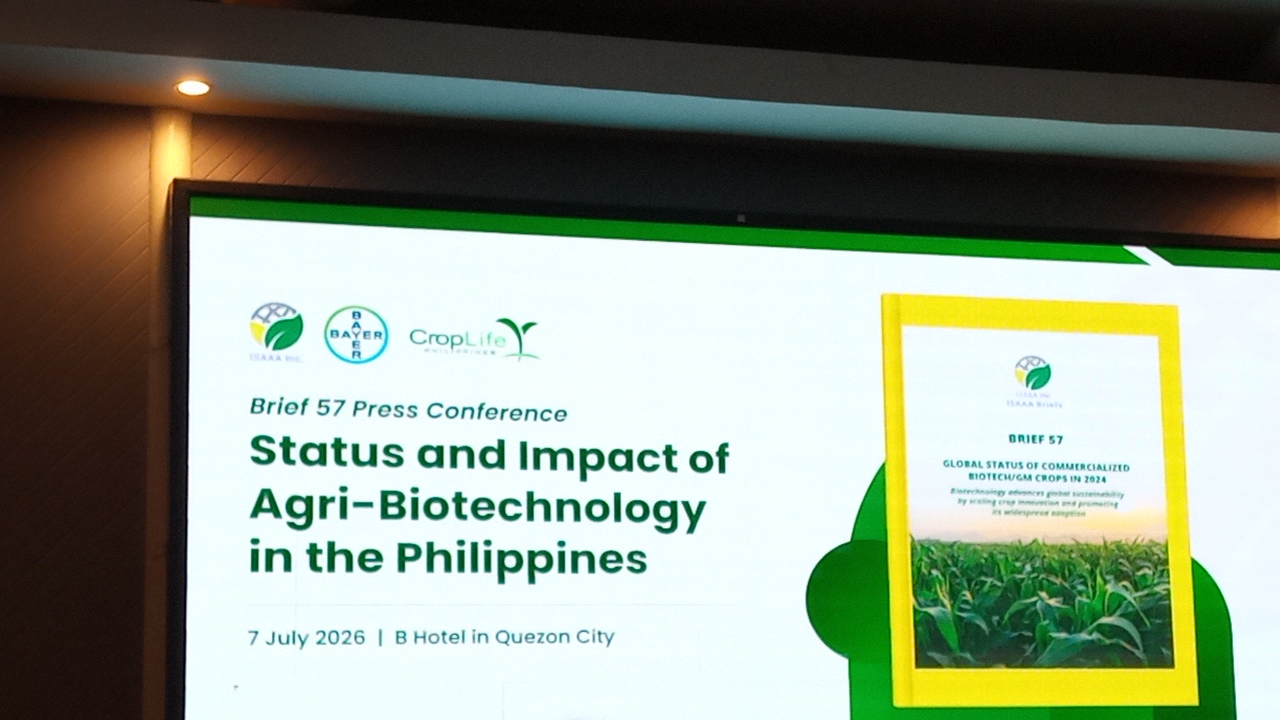
QUEZON CITY — Biotechnology stands as an essential component in building sustainable and strengthened national food security, according to former Agriculture Secretary and ISAAA Inc. Board Chair Dr. William Dar.
Dar made the statement during the press conference titled “Status and Impact of Agri-Biotechnology in the Philippines,” held this July 7 at the B Hotel. The event was organized by the International Service for the Acquisition of Agri-biotech Applications (ISAAA Inc.) in partnership with Bayer and CropLife Philippines.
“Biotechnology is an essential component for sustainable and strengthened national food security,” Dar emphasized. He noted that the Philippines has emerged as a regional leader in the responsible adoption of agricultural biotechnology, adding that Filipino farmers have embraced innovation to improve their livelihoods while ensuring scientific advancements translate into tangible benefits on the ground.
Modernizing Agriculture
Mr. Ramon Abadilla, Executive Director of CropLife Philippines, highlighted the role of modern biotechnology in advancing local farming. He compared the evolution of agricultural innovation to other industries, citing everyday materials: “Nylon, originally used for women’s stockings, is now used for parachutes, industrial piping, and bulletproof gear. Similarly, Teflon has critical applications in aircraft technology. This same principle applies to biotechnology — it evolves to serve greater needs.”
From Farm Experience
Ryan Lising, a biotech corn farmer from Mandani, Magalang, Pampanga, shared how the technology transformed his life. “Planting Bt corn has been life-changing. It reduced pest damage, lowered production costs, and gave my family more stable income and better opportunities,” he said.
20 Years of Growth & Impact
Kristine Grace Tome, Manager of the ISAAA Global Knowledge Center on Biotechnology, presented key milestones:
 The Philippines was the first country in Southeast Asia to approve biotech crops in 2002 and begin commercial planting in 2003.
In 2024, it ranked 13th among 31 countries growing biotech crops worldwide.
Area planted to biotech corn reached 709,000 hectares in 2024.
Over the past 20 years of commercialization, economic gains have benefited more than 673,099 Filipino farmers and their families.
Looking ahead, organizers expressed their vision for locally developed biotech crops — including “Pinoy cotton” and Bt eggplant — that will be resistant to pests and fully suited to Philippine conditions.
| Mary Jane Olvina | 10:26 AM (6 minutes ago) | ||
to me |


6 thoughts on “Biotechnology Seen As Key to Sustainable, Stronger National Food Security-Dar”