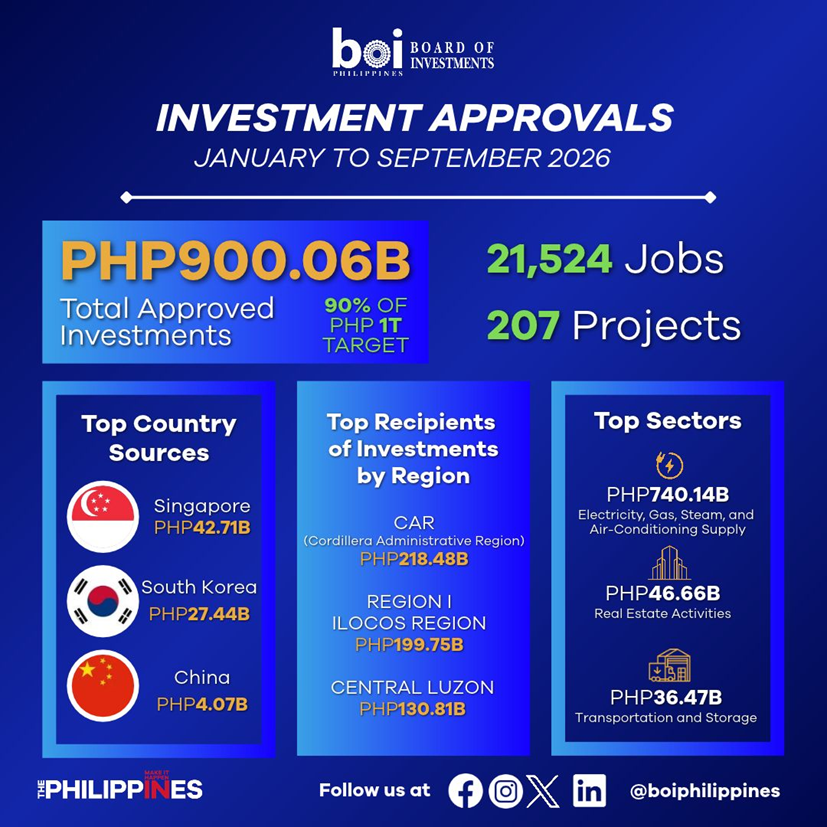
Investor interest in the Philippines continued to strengthen as the Board of Investments (BOI) approved Php900.06 billion worth of investments from January to September 2026. This represents a 53.05% increase from the same period last year, successfully achieving 90% of its Php1 trillion full-year target with three months remaining in the year.
The 207 projects are expected to generate 21,524 jobs for Filipinos. In September alone, investment approvals reached Php278.21 billion, nearly five times the Php56.49 billion recorded in September 2025. The monthly figure represented a 392.5% increase and covered 27 approved projects projected to create at least 2,068 jobs.
Trade Secretary and BOI Chair Cristina A. Roque highlighted that hitting the ₱900-billion investment approvals with a full quarter still remaining proves the effectiveness of the Marcos Jr. administration’s reforms to improve the country’s business environment.
“The surge in investment approvals recorded during the first nine months of 2026 reflects growing investor interest in the Philippines as a premier destination for growth and expansion. The DTI through BOI will continue pursuing investments that advance our industrial capabilities, drive technological innovation, and generate high-value employment nationwide,” Secretary Roque said.
Surge in Investments Across Various Sectors
The approvals reflect sustained investor interest across a broad range of sectors, particularly energy, infrastructure, logistics, digital industries, and tourism-related activities, underscoring interest in the country’s long-term growth prospects.
Notably, the electricity, gas, steam, and air-conditioning supply industry remained the main driver of the investment approvals, accounting for Php740.14 billion, or 82.23% of the total approved investments. This highlights the continued momentum of investments in the country’s energy sector.
Investment approvals in the sector rose by 75.2% from Php422.34 billion in the first nine months of 2025 to Php740.14 billion during the same period in 2026. These projects are expected to generate 1,903 jobs, representing a 71.6% increase from 1,109 jobs recorded a year earlier. The sector’s performance was driven by the approval of major hydropower, wind, solar, and other energy projects.
Other leading sectors included real estate activities with Php46.66 billion in approved investments, transportation and storage with Php36.47 billion, information and communication with Php18.36 billion, and manufacturing with Php14.86 billion. Investments in the information and communication sector nearly doubled, posting a 96.47% increase from the previous year.
Several sectors also posted significant gains. Accommodation and food service activities grew by 265.5% to Php8.13 billion, while water supply, sewerage, waste management, and remediation activities surged 3,116.6% from Php209.73 million to Php6.75 billion. Wholesale and retail trade, including the repair of motor vehicles and motorcycles, increased by 314.7% to Php3.75 billion.
Domestic Investments Dominate Approvals
Domestic investors continued to account for the bulk of investment approvals, contributing Php808.96 billion, or 89.88% of the total approved investments. This represented a 60.5% increase from Php503.95 billion during the same period in 2025.
Among regions, the Cordillera Administrative Region (CAR) attracted the highest level of approved investments at Php218.48 billion, followed by the Ilocos Region with Php199.75 billion, Central Luzon with Php130.81 billion, Eastern Visayas with Php76.84 billion, CALABARZON Region with Php58.37 billion, and the National Capital Region with Php49.88 billion.
Caraga registered the fastest growth, with investments rising 1,731.5% from Php924.7 million to Php16.94 billion. Western Visayas posted a 296.5% increase, from Php10.79 billion to Php42.77 billion, while the Ilocos Region recorded 136.6% growth from Php84.41 billion to Php199.44 billion.
Foreign Investment Commitments Maintain Strong Momentum
Foreign investor interest likewise remained robust, with several of the Philippines’ key investment partners significantly increasing their commitments during the period. Foreign investments reached Php90.40 billion as of September 2026. Singapore remained the top source of foreign investments with Php42.71 billion, accounting for 46.9% of total foreign investment approvals, followed by South Korea with Php27.44 billion, China with Php4.07 billion, Japan with Php3.11 billion, the Netherlands with Php2.15 billion, Australia with Php1.57 billion, and the United States with Php1.33 billion.
Compared with the same period in 2025, investments from South Korea increased by 10,332.7%, from Php263 million to Php27.44 billion; investments from Australia increased by 657.3%, from Php207.9 million to Php1.57 billion; while investments from China grew by 348.1%, from Php908.2 million to Php4.07 billion.
“As we enter the final quarter in 2026, the BOI will continue to actively promote the Philippines as a prime destination for investments. The strong approvals recorded thus far demonstrate not only the resilience of the Philippine economy but also the interest of investors in the country’s long-term growth prospects. We remain optimistic that investment momentum will continue through the remainder of the year,” said Trade Undersecretary and BOI Managing Head Ceferino S. Rodolfo.
As the nation’s primary investment promotion agency, the BOI continues to strengthen the country’s investment climate through policy development, investment facilitation, and strategic promotion initiatives. This year, the agency spearheaded the formulation of the Strategic Investment Priority Plan (SIPP), which identifies priority sectors and activities eligible for incentives under the CREATE MORE Act, while also leading the implementation of the Green Lane for Strategic Investments to expedite the processing of high-impact projects.
The strong investment pipeline, sustained domestic participation, and increasing foreign commitments underscore continued investor interest in the Philippines and position the country to maintain its investment momentum through the remainder of 2026 and beyond. END

